Structural Drying in South Jordan, UT
Drywall that feels dry can still hold water in the bottom plate, the insulation and the concrete beneath it. Dehumidifiers, air movers and daily readings dry every layer in South Jordan until the numbers match a dry reference.
(888) 558-4812Call about drying the wet walls and floors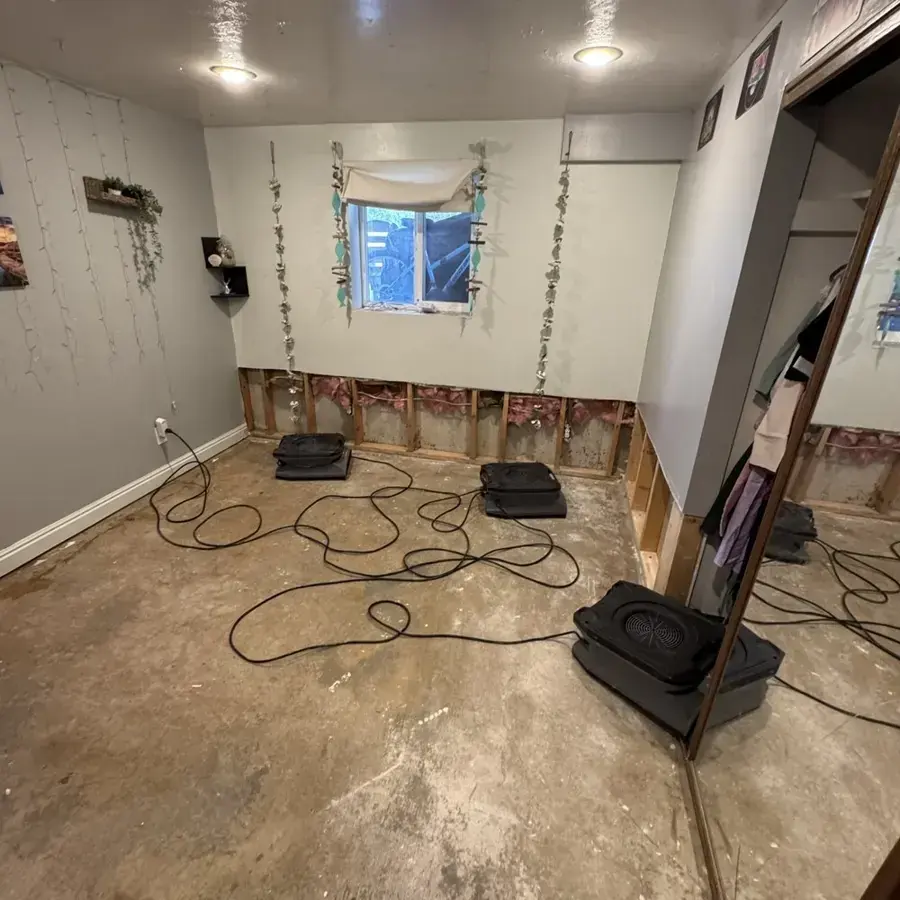
What to do first about structural drying in South Jordan
Keep doors closed
Close doors and windows in wet rooms and leave equipment running, since drying works best sealed.
Leave equipment alone
Do not move equipment or meters, and keep other fans and heaters off.
Remove what is flagged
Let the crew pull wet pad, baseboard or drywall that cannot dry, rather than covering it with flooring.
Watch the power use
Equipment runs around the clock, so expect noise and higher power use, and keep cords off wet surfaces.
How structural drying is handled in South Jordan, UT
Map and set targets
Meters and thermal imaging map the wet areas, and readings from dry materials set the target.
Set equipment
Dehumidifiers and air movers are placed by room volume and wet surface, with cavities opened where needed.
Monitor daily
Each visit records temperature, humidity and moisture at the same points, and equipment is adjusted.
Confirm and remove
Equipment comes out only when every material matches the dry reference, and the logs are handed over.
What does structural drying cost in South Jordan, UT?
Drying a single room at Class 1 to 2 costs $1,200 to $2,800. A basement or several rooms cost $2,800 to $8,000, and Class 4 drying or a whole level costs $7,000 to $15,000+.
Single room, light Class 1 to 2
- Air movers and a dehumidifier
- Readings every day
- A short equipment run
Basement or multi-room job
- Dehumidifiers across the space
- Wall cavities dried
- Daily climate logs
Class 4 drying or full level
- Desiccant or specialty units
- Hardwood and concrete dried
- Longer equipment runs
These are typical ranges, not a quote. The water category, the square footage, the material class and how fast drying started move the number most. For a closer planning range, run the water damage cost calculator.
After the standing water is gone, most of a water job is structural drying: removing the moisture held in framing, concrete, subfloor and wall cavities, which only controlled airflow and dehumidification can do.
How structural drying works
Three measurements set the equipment and the end point.
- Temperature and humidity in the air, logged daily to show the room is drying.
- Moisture content of wood, drywall and concrete, taken at fixed points.
- Dry reference readings from the same materials in an unaffected area.
Structural drying near the Jordan River
The City reports that neighborhoods along 1300 West and close to the Jordan River may see high groundwater after winter precipitation, and in March 2024 KUTV reported groundwater filling a sump well beside the river. The Utah Geological Survey released 10 geologic-hazard maps in July 2014 for part of western Salt Lake Valley that includes portions of the city, covering shallow groundwater and flooding among other hazards.
Structural drying in finished basements
Finishing a basement takes a City permit, so framing, insulation and flooring in a wet finished basement call for measured drying, not a quick fan. Basement flooding cleanup and water extraction usually come first. The EPA covers indoor air and the Utah Geological Survey covers groundwater maps.
Structural Drying and Dehumidification questions in South Jordan, UT
What sets the length of a structural drying job?
Rooms usually need several days, and a wet finished basement can take longer. Drying ends once every reading matches its dry reference, not on a calendar date.
Why do the dehumidifiers run all day and night?
Moisture keeps coming out of wet materials as long as the air can take it, so equipment runs continuously until readings show the materials are dry.
Why does drying take longer in concrete?
Concrete holds water in tiny pores and releases it slowly, so concrete floors keep reading wet after drywall and carpet are dry.
Can a wet hardwood floor be dried?
Often, when drying starts before the boards cup and the subfloor is dried too. Panels and mats pull moisture from the boards, and badly cupped floors may still need replacement.
Is drying needed if the drywall looks fine?
Yes. Insulation, bottom plates and concrete can stay wet behind intact drywall, and trapped moisture lets mold start in 24 to 48 hours.
Who decides when the equipment can leave?
The readings do. Each material has to match its dry reference, and the logs showing that are handed to the owner and the adjuster.
Structural drying across South Jordan, UT
Structural drying covers South Jordan homes and offices in ZIP codes 84095 and 84009, from Mabey Lane Estates and Park Place Subdivision to Daybreak, including finished basements near the Jordan River and 1300 West, wherever readings stay high.
The same service nearby: structural drying in Riverton, Herriman, Bluffdale.
Water damage restoration in South Jordan · every area covered
Structural drying in South Jordan?
Equipment is sized to the rooms, readings are logged daily, and nothing is removed until every material reads dry.